Summary: The best patient acquisition agency for a small Georgia practice depends on where it is losing appointments. Linx is the most direct fit for an integrated clinic with a defined service to promote and an intake process ready for more leads. For a confusing booking website, consider Persist Marketing; for weak search visibility, consider PilotPractice. Match the agency to the bottleneck before expanding services.
Consider an illustrative front-desk scenario: a patient says the booking link sent them to the wrong place. The receptionist offers to take the appointment by phone, but the patient has already gone to another clinic with a cleaner path from search to schedule.
For a small Georgia practice, this scenario is a reason to check the whole booking path rather than assume a thin calendar comes from an isolated marketing tactic. Paid ads, map results, organic search, and the booking page all shape the same patient decision. The best patient acquisition partner is the agency that fits the problem you actually have.
My view is narrow and practical. Small Georgia practices should not buy the broadest medical marketing package first. They should buy the channel that fixes the next missed appointment, then add services only when the practice can answer calls, honor online booking, and track booked patients by source.
How this Georgia agency shortlist is organized
This shortlist groups agencies by the marketing need discussed in each profile, rather than ranking them by verified patient outcomes. Read ‘best’ as a fit judgment for a particular practice, not proof that an agency outperforms its competitors. The linked agency pages describe services; they do not establish what your practice would pay or how many patients a campaign would bring in.
The comparison does not present client interviews, independently audited campaign results, or a hands-on test of each agency. The front-desk scenario above is illustrative, not a reported patient case. Use the profiles to prepare questions about scope, intake readiness and reporting, then ask for evidence relevant to your specialty and Georgia service area. A service listed on an agency website is a starting point for that conversation, not a guarantee of availability or results.
1. Linx: paid advertising for integrated medical clinics
Linx in Atlanta provides paid advertising for integrated medical clinics, which makes it the most direct fit on this list when a practice already knows what service line it wants to fill. Paid media suits clinics with appointment capacity, a defined offer, and a receptionist or intake workflow ready for a faster stream of leads.
Linx fits a small integrated clinic better than a practice that still needs its first credible website or search presence. A paid advertising program exposes weak intake quickly. Unclear landing pages, slow callbacks, and mismatched booking links turn spend into noise.
If the practice has those basics in place, paid ads give the owner a focused way to test demand for a specific service before committing to a wider patient acquisition plan.
Before speaking with Linx, write down the service line, the appointment type the clinic can offer, and the booking route a patient should use. Ask how the proposed campaign would connect each ad to a page that explains that service, instead of sending every searcher to the same general homepage. That gives the practice a concrete plan to judge, not just a promise of more traffic.
Set a review point around the result the clinic can verify, appointment requests that name the advertised service. Clicks alone cannot show whether the ad brought in a prospective patient who could book. If staff cannot identify those requests, agree on a simple intake question or source field before the campaign starts.
2. RXMedical Designs: digital marketing for clinics and professionals
RXMedical Designs in Atlanta offers digital marketing for clinics and healthcare professionals, which suits a practice that wants one partner for several channels instead of a single-channel vendor. That matters when a small clinic is dealing with several weak spots at once.
Poor local visibility, stale messaging, and no steady way to turn website visitors into appointment requests can all sit there together. RXMedical Designs fits owners who want medical practice marketing services arranged around the clinic as a whole. The trade-off is focus. A broad scope works only when the practice names the first result it needs, such as more calls from a service page or more appointment requests from search.
Without that decision, broad marketing strategies for medical practices tend to create activity before they create booked visits.
A practice that is considering broad support should decide which work starts first and what the clinic has to supply before it starts. If clearer service messaging comes first, the clinic needs to know who approves the wording and which existing pages or materials the agency will use. If appointment requests come first, ask how the agency will tell those requests apart from general site activity.
That first milestone also helps keep a broad engagement manageable for a small staff. An owner can compare the agreed work with what actually changed, then decide whether the next need is search visibility, website content, or another part of the plan. The agency's stated offer is broad, and the practice still has to set the first measurable job.
3. Vette Marketing: patient generation for specialty practices
Vette Marketing in Atlanta focuses on generating patients for specialty medical practices, which makes it a fit for clinics whose patient acquisition problem is tied to a defined service line. Specialty practices often need different language than general primary care, because the patient is weighing symptoms, eligibility, and trust signals before booking. Vette Marketing belongs on the shortlist when a Georgia practice already knows its specialty growth target and wants marketing built around that demand.
A dermatology, aesthetics, orthopedic, or other specialty clinic should ask how the agency separates qualified patient interest from general website traffic. The stated focus on specialty medical practices helps only if the campaign also matches how patients choose that kind of care.
A specialty clinic can get ready for that conversation by listing the questions its front desk answers before a patient schedules. The agency can then explain how those questions might show up in campaign messaging and what a landing page needs to support the booking decision. The practice should review that language for accuracy before it goes live.
Ask Vette Marketing what it would count as a suitable patient inquiry for the chosen service. A form submission that does not give enough information to route the patient is different from a request the front desk can act on. Agreeing on that difference early gives the clinic a more useful basis for reviewing results.
4. PilotPractice: medical SEO for patient attraction
PilotPractice in Atlanta provides medical SEO for practices that want patients to find them through search and keep finding them there. It fits clinics that need steady visibility more than a quick burst of paid leads. SEO makes sense first when a clinic offers useful services but does not show up clearly for the searches people use before they call.
PilotPractice fits owners who are willing to build pages, listings, and search relevance around the services they actually provide. A practice should not pick SEO because it seems cheaper than ads. It should pick SEO when the website can become a dependable intake asset.
If the owner needs visits this month and has no organic footprint, paid advertising may need to run while SEO work grows.
Before you commit to SEO, list the services the clinic really offers and check whether each one has its own page, accurate details, and a route to schedule. That gives the agency a place to start when it talks about pages that need work. It also keeps the scope tied to patient-facing information instead of a vague goal like "rank higher."
Ask how progress will be reviewed while search work is happening. A clinic can look at whether the target pages are being updated and whether the content matches its actual services, then track appointment requests separately. That distinction matters because search visibility is an intermediate signal, not proof that a patient booked.
5. Persist Marketing: booking-focused healthcare websites
Persist Marketing in Atlanta builds healthcare practice websites meant to support appointment bookings, so it fits clinics whose marketing problem starts after the patient clicks. A weak website can waste every other channel because the patient still needs a clear path from service interest to scheduling.
Persist Marketing is worth considering before heavier media spend when a practice website hides the phone number, sends patients to a confusing form, or fails to explain services in plain language. Website work is less flashy than lead generation, but it is often the constraint that makes ads and SEO look worse than they are. A clinic with a dated site should fix the booking path before asking any agency to increase traffic.
A practice can test that path without guessing why patients leave. Open the site as a new visitor, choose a service, and try to reach the appointment step. Notice whether the service description, contact information, and booking option are easy to find. Those observations give Persist Marketing specific problems to discuss instead of a general request for a redesign.
The clinic should also identify who will maintain service details and booking links after launch. If appointment options change, an outdated page can undo the clarity the new site was meant to create. Agreeing on who checks those details makes the website a steadier part of the acquisition process.
6. Southern Exposure Media Group: Google Ads and search visibility
Southern Exposure Media Group in Atlanta handles medical practice marketing, including Google Ads and search visibility, so it suits clinics that want paid search and organic visibility judged together. For a small practice, that mix matters when high-intent searches need attention now and search presence has to grow over time. Southern Exposure Media Group can work for a clinic that wants one partner watching both immediate demand and search discovery.
The owner should ask whether Google Ads and search visibility will be reported as separate workstreams, because paid clicks and organic discovery answer different questions. A single dashboard helps only when it still shows which channel brought appointment requests.
During the sales conversation, ask the agency what happens if paid search brings in requests while organic visibility stays limited. The reply should show which work is meant to address near-term demand and which is meant to build discoverability over time. A combined scope does not remove the need to understand each channel's role.
The clinic can also ask how staff should pass along booking outcomes. If a caller mentions an ad or a search result, recording that source gives the practice a practical way to compare it with online requests. Without a consistent handoff, reports may show activity without telling the owner which work led to a scheduled visit.
How should a small practice choose among them?
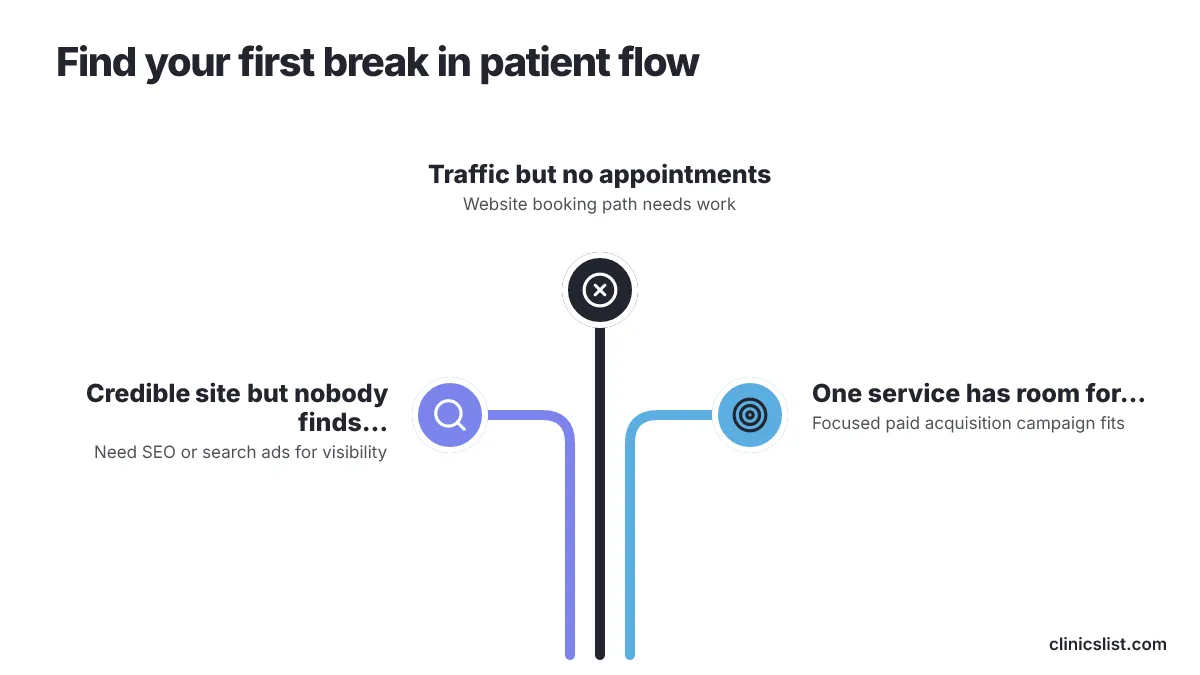
A medical practice marketing agency should be chosen from the first break in patient flow, not from the biggest list of services. If a clinic gets traffic but no appointments, the booking page needs work. If the website looks credible but nobody finds it, the fix is SEO or search ads. If one service line has room for more patients, a focused paid acquisition campaign fits better.
Use this order before taking sales calls:
- Name the service line that needs new patients, such as urgent visits, imaging, aesthetics, dental care or a specialty consult.
- Check whether the clinic can accept the next appointment without asking the patient to call twice.
- Decide whether the main problem is demand, search visibility, website conversion or follow-up.
- Ask each agency to describe the first month of work without using a generic channel bundle.
- Require reporting on appointment requests, not only clicks, impressions or page views.
A practice that wants one team for paid campaigns and local visibility can also look at Clinads' medical clinic marketing. Clinads describes its offer as one AI-powered marketing team for dental and medical clinics that builds, manages, and optimizes campaigns to book patients and improve local visibility. Ask whether the proposed work matches the clinic's first bottleneck and operating capacity.
ClinicsList publishes a searchable clinic directory for finding clinic information. When reviewing a listing, check the details relevant to a prospective patient, such as location, insurance, language and appointment access, against the practice's own current information rather than treating directory inclusion as verification of every detail.
That matters for acquisition because patients rarely experience marketing as separate channels. They compare trust signals, access and booking clarity in one search session.
Lisa Landsman's LinkedIn post discusses choosing which appointment and reservation links appear on Google, including Google Business Profile booking controls. Treat this as a prompt to review the booking links visible on your own listing, not as confirmation that every clinic has the same controls. Check the options available in the practice's account before changing a campaign's booking route, and test where each visible link sends a prospective patient.
When comparing medical practice marketing services, ask every agency how it handles the handoff from discovery to booking. Use the profiles as a fit checklist, not a performance league table:
| Agency | Need emphasized in this comparison | Question to resolve before choosing |
|---|---|---|
| Linx | Paid advertising for integrated clinics | Can the proposed campaign connect a defined service to a workable intake route? |
| PilotPractice | Medical SEO and search visibility | Which service pages and listings would the proposed work address? |
| Persist Marketing | Website and booking-path clarity | Who will maintain service details and scheduling links after launch? |
| Southern Exposure Media Group | Google Ads alongside search visibility | Will paid and organic appointment requests be reported separately? |
| RXMedical Designs | Broader digital marketing support | Which deliverable comes first, and who approves it? |
| Vette Marketing | Specialty patient generation | How will the practice define a suitable inquiry for its service? |
The cheapest correct option is sometimes no agency contract yet. A solo practice with no reliable call handling should fix intake scripts, voicemail routing and booking links before buying ads, because new leads will only expose an operational problem faster. A small practice with a working website and unused appointment capacity can justify paid acquisition sooner, because the system is ready to receive demand.
A solo practice in South Carolina or a multi-location practice in Nebraska should not treat this Georgia shortlist as the automatic answer. The same selection logic applies, but the agency still needs proof that it understands the practice's local search environment, patient mix and operating model. For those searches, the best patient acquisition marketing agency for a solo practice in South Carolina or for multi-location practices in Nebraska is the one that can show local fit, not the one that happens to rank well for Georgia.
Healthcare tools outside marketing can still affect acquisition when they change clinic capacity. VELMENI dental AI imaging software is presented by its vendor as dental AI imaging software with detection and workflow features.
That product description should not be read as independent evidence of improved diagnostic accuracy or practice efficiency. Ask for evidence supporting any proposed clinical or operational benefit before including it in a purchasing decision or patient-facing marketing.
A dental practice choosing between software and a medical marketing agency should be honest about the constraint. If the calendar is empty, check whether demand or the booking handoff is the constraint before choosing either purchase. If chairside workflow is the bottleneck, operations may matter before more leads.
These are different purchasing decisions: a software demonstration is not evidence that a practice needs more advertising, and an advertising proposal is not evidence that the practice needs a diagnostic tool. Keep the clinical assessment separate from the marketing comparison.
Small practices that want a neighboring benchmark can compare this Georgia list with Texas clinic marketing agencies to see how agency fit changes by market and service mix. Clinics in weight-loss care can also review a semaglutide marketing agency comparison when the acquisition problem is tied to one regulated, high-demand treatment category.
What should the proposal and reporting make clear?
A useful proposal states what the agency will do, what the practice must supply, and how staff will distinguish inquiries from scheduled visits. Ask for a written scope rather than treating the service categories in this article as a complete description of an engagement.
- Deliverables and approvals: Identify the pages, campaigns or booking-path changes included, who approves patient-facing wording, and which responsibilities stay with the practice.
- Relevant evidence: Ask for examples from a comparable specialty and service area, with enough context to distinguish an agency's contribution from changes in staffing or appointment availability. A testimonial alone is not a forecast for your practice.
- Access and ownership: Clarify who controls the advertising accounts, website assets, reporting access and changes to booking links, including what happens when the engagement ends.
- Costs and commitments: Request the proposed service fee, advertising spend, optional work and cancellation terms in writing. This comparison does not provide verified prices or contract terms.
- Reporting definitions: Agree on what counts as an inquiry, a suitable request and a scheduled appointment. Ask how duplicate requests and cancellations will be handled rather than comparing unlike totals.
- Tracking review: Have the practice's compliance owner review proposed forms, tracking tools and access to booking data before implementation. Use test details when checking the booking journey, rather than putting real patient information into a demonstration.
Treat traffic, requests and bookings as different checkpoints. If interest increases without scheduled visits, review the booking handoff before assuming that a broader marketing package is the answer. If the practice cannot connect an inquiry to an appointment outcome, say so in the report instead of labelling every click a new patient.
Choose the agency around your booking bottleneck
Start with one appointment type and one broken handoff. If patients cannot find the clinic, talk to the SEO and search visibility options first. If patients find the clinic but do not book, start with the website and booking path. If the path already works and capacity is open, paid advertising becomes a reasonable first contract.
The work takes a named owner inside the practice, access to booking data and a willingness to cut channels that do not produce appointment requests. This advice stops at agency fit; contract terms, clinical claims, advertising approvals and compliance review need the practice's own legal and clinical judgment before money changes hands.
Frequently Asked Questions
Which patient acquisition agency is best for a small medical practice in Georgia?
For a small Georgia practice, the right agency depends on whether the main gap is paid demand, search visibility or the booking path. Linx is the most direct fit for an integrated clinic with a defined service to promote and an intake process ready for more leads. Persist Marketing may suit a practice with a confusing booking website, while PilotPractice may fit one with weak search visibility. Identify the bottleneck before expanding services.
Which Georgia agency should I consider for paid advertising to attract patients?
Linx is the article’s paid advertising option for integrated medical clinics. It may fit a small practice that has appointment capacity, a defined service to promote, and staff ready to handle a faster stream of leads. Before starting, clarify which appointment the campaign should promote and how each ad will connect to a relevant service page and booking route.
Which agency should I consider if my practice website makes booking difficult?
Persist Marketing builds healthcare practice websites intended to support appointment bookings. It may be worth considering when patients have trouble finding service information, contact details, or a clear scheduling route. The article recommends testing the patient journey first: choose a service on the site and try to reach the appointment step. Note any confusing points and discuss who will maintain booking links after launch.
Should a small Georgia practice choose SEO or paid advertising first?
A small Georgia practice should consider SEO for weak search visibility and paid advertising for a defined service campaign when intake is ready. PilotPractice provides medical SEO for clinics seeking ongoing visibility, especially when the practice offers useful services but is hard to find in search. If the clinic needs visits soon and has no organic footprint, the article says paid advertising may need to run while SEO develops. A ready intake process matters for paid leads.
How can a small practice tell whether its marketing agency is bringing in patients?
Track appointment requests separately from clicks or general website activity. For a paid campaign, the clinic can identify requests that name the advertised service, using a simple intake question or source field agreed on before launch. For specialty marketing, clarify what counts as a suitable inquiry. These measures help staff distinguish requests they can act on from activity that does not show a patient booked.
Related reading
- 5 Best Clinic Marketing Agencies for Small Texas Practices
- Semaglutide Marketing Agencies: Compare Your Options
Sources
- Linx
- RXMedical Designs
- Vette Marketing
- PilotPractice
- Persist Marketing
- Southern Exposure Media Group