Summary: The top medical clinics in North Carolina vary by care need, with Duke University Hospital in Durham for complex care, UNC Health Rex in Raleigh for family care, ECU Health for eastern North Carolina coverage, WakeMed for Wake County access, and Novant Health Presbyterian Medical Center in Charlotte for emergency care. Each offers unique strengths depending on the patient's specific requirements.
Patients looking for top medical clinics in North Carolina usually do not need an abstract scorecard from some institution. What matters is whether a place takes a specific insurance card on Tuesday morning, sees a sick child without a three-week wait, or handles specialized surgery without a four-hour drive across county lines. When clinic directories collapse a whole state into one flagship hospital tower, people who need routine care or regional care end up sent the wrong way.
Healthcare facilities across the state do not all serve the same purpose, and patient needs do not line up neatly either. A Charlotte resident in an acute health crisis needs a fast hospital intake route. A dental practice in the Piedmont may lose dozens of scheduled appointments each month because manual intake piles up. Picking the right medical facility in North Carolina means matching the setting to the exact clinical or administrative task.
The right site of care comes from verified directory data, not prestige marketing. Platforms such as ClinicsList offer a searchable verified clinic database covering more than 90,000 facilities nationwide, with filters for insurance networks, language support, telehealth services, and direct scheduling capabilities, so patients and operators can look at the clinical facts directly.
1. Clincy: best for dental intake and reactivation
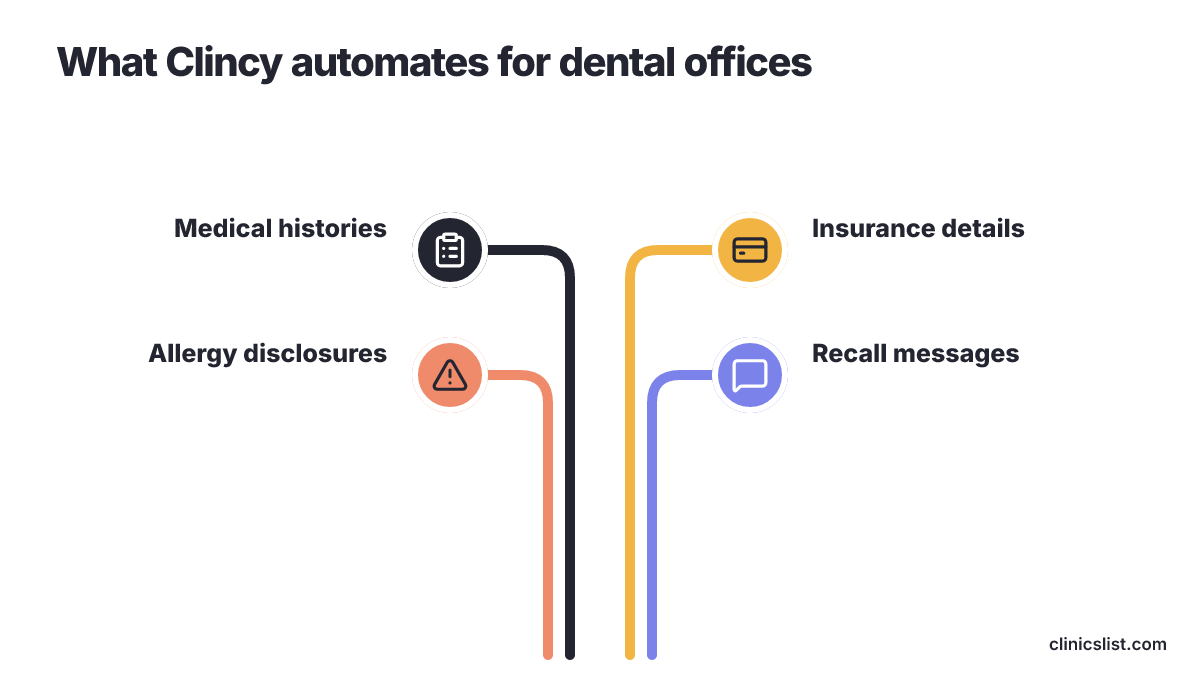
Dental offices lose hours of production time each week chasing new patient forms, insurance paperwork, and recall messages that never get answered. The Clincy patient intake platform works as an automated administrative coordinator for oral healthcare practices. It gathers medical histories, insurance policy details, allergy disclosures, and contact information before patients arrive, which shifts the administrative load away from the front desk. Practice management systems get structured data straight from the automated workflow, so staff do not have to retype the same information over and over. The platform also reaches out to inactive patients who have drifted away from routine care intervals, booking them back into open hygiene chairs and helping keep schedule gaps from cutting into revenue.
General medical groups, hospitals, and primary care centers should look elsewhere, since the platform is built entirely for dental practice management setups. The provider has not released public pricing schedules, so practice administrators have to request software integration requirements and subscription costs directly when they compare digital coordinators with staffing budgets.
2. Duke University Hospital: best for ranked complex care
Academic medical centers treat patients with severe, rare, or multisystem diagnoses that community clinics cannot handle alone. Duke University Hospital in Durham holds the top-ranked hospital position in North Carolina, and it serves as a primary tertiary referral center across the Southeast. Complex oncological cases, advanced surgical interventions, and rare chronic disorders are the main clinical reasons people seek care inside this university health system. Medical specialty evaluations across the state changed in structure when U.S. News & World Report announced in August 2026 that its 2026-2027 Best Hospitals release added regional specialty rankings for Cancer, Cardiology, Heart & Vascular Surgery, Orthopedics, and Rehabilitation. Patients looking at care now have regional department data to compare instead of a single statewide institutional label, and that puts local clinical performance into view across separate disease categories.
The university network keeps pushing its physical reach southward toward Mecklenburg County. Reporting by NC Newsline and Enlace Latino NC in October 2026 said that Duke Health joined with a partner system to submit Charlotte-area hospital applications that would build 200 inpatient beds, with an expanded outpatient clinic footprint possibly taking shape in the early 2030s.
Prestige does not guarantee easy outpatient access or lower out-of-pocket costs for ordinary visits. Patients who need quick routine consults or basic family medicine often run into long specialist scheduling queues, and that makes an academic medical center a poor fit for standard primary care needs.
3. UNC Health Rex: best for family care in Raleigh
Community health networks cover the steady middle of medicine. They handle pediatric visits, annual exams, and the ordinary referrals a household collects over decades, and UNC Health Rex in Raleigh presents its sites as a long-running base for family medicine across Wake County and the central Piedmont.
Managing several calendars gets messy quickly. A coordinated network keeps children, adults, and aging parents tied to one clinic directory, so families do not end up chasing separate systems for every stage of care.
The useful part shows up when people move through life under one roof. A household booking baby visits, maternal checks, and adult physicals can move between departments without spending afternoons faxing charts from one office to another.
Visible community branding does not mean you will find clear outpatient prices or quick appointments at every subspecialty clinic. The system publishes neither fixed price lists nor firm wait times, which leaves people with complex or aggressive diagnoses to verify insurance coverage and local clinic capacity before they schedule.
Investors and practice managers can study how regional networks hold patient volume by relying on neighborhood reputation. Public materials, though, leave out almost everything about intake delays, referral drop-off rates, or how individual offices perform financially.
4. ECU Health: best for eastern North Carolina reach
Rural and coastal towns run into real trouble finding nearby specialists and steady outpatient care. Residents often spend hours on the road for routine checks. Operating as a mission-driven 1,447-bed health system, ECU Health handles care for 1.4 million people spread across 29 eastern counties. That coverage acts as a safety net for farming and coastal communities far from the large university centers.
The network is built around 12,000 health system employees and eight ECU Health hospitals, with support from local wellness centers, hospice programs, visiting nurse agencies, and the ECU Health Physicians multi-specialty group. In practice, a rural setup like this can move a local doctor visit in a small town straight into regional inpatient beds if a patient needs serious hospital care.
If you live in the Piedmont, the Research Triangle, or the Charlotte area, an eastern clinic footprint may have little bearing on your weekly life. A large hospital count looks good on paper. It helps only when the exam rooms sit close enough to your driveway to matter.
Geography matters more than a famous regional logo. A nearby community clinic that follows your recovery closely gives better care than a prominent facility three hours away when all you need is routine lab work.
5. WakeMed: best for Wake County access
Dense counties need several layers of care, with ordinary neighborhood clinics sitting beside full emergency rooms. The WakeMed health services profile describes a unified county footprint built from three WakeMed hospitals, eight emergency departments, dedicated pediatric inpatient units, and 80+ physician practices. That concentration lets Wake residents handle primary appointments, quick urgent care stops, and major trauma without crossing county lines.
Shared medical records keep patients from repeating scans or fighting broken referral chains. Someone seen in an emergency bay can walk into follow-up visits with a network specialist or local doctor who is already looking at the same imaging records and lab draws. Governance across Wake County is changing right now. As reported by The Assembly NC in September 2026, Wake County Commissioners voted 5-2 after four months of public meetings to approve their WakeMed merger approval, a move that reshuffles administrative control across regional medical sites.
Changes of that size can disrupt insurance agreements, physician contracts, and regional referrals while operations are being combined. Patients need to check clinic insurance status before appointments, and rival operators have to track how this combined regional leverage affects daily local competition.
6. Novant Health Presbyterian Medical Center: best for Charlotte emergency care
Severe acute illness and traumatic injuries require immediate access to full-scale inpatient resuscitation and advanced emergency teams. Located in the core of Mecklenburg County, Novant Presbyterian Medical Center delivers emergency medical treatment and intensive inpatient services to urban residents, commuters, and travelers visiting Charlotte. Patients facing sudden clinical emergencies in the central city rely on the facility for around-the-clock emergency care.
The facility has operated continuously within the municipal core since 1903, establishing deep community roots across more than a century of clinical expansion. While longevity demonstrates institutional stability, patients still need to confirm current physician staffing, specific specialty coverage, and payer network participation for non-emergency situations.
Hospital capacity throughout the Charlotte metropolitan region continues to undergo regulatory scrutiny and competitive challenges from competing health systems.
Emergency department facilities are engineered for crisis stabilization rather than ongoing outpatient treatment. Patients seeking simple diagnostic screenings, elective joint replacements, or ongoing diabetes management should schedule visits with outpatient specialty clinics rather than checking into a hospital emergency center.
How should you choose among North Carolina clinic options?
Clinical decisions should begin by defining the specific medical task rather than default prestige scores. An overwhelmed dental office must evaluate automated intake tools to resolve front-desk delays, an individual with a suspicious oncology finding needs regional academic specialty ratings, and a family seeking routine care needs an in-network primary care doctor five minutes from home.
Hospital league tables function as rough initial screens rather than definitive guidance. The August 2026 U.S. News & World Report release introduced regional specialty rankings, proving that an institution with an impressive general hospital score may rank behind regional peers in specific fields such as cardiology, cancer care, orthopedics, or rehabilitation.
Practice operators must evaluate where care journeys begin and how patients navigate follow-up appointments. WakeMed provides dense county-level outpatient saturation, ECU Health maintains expansive rural reach across 29 counties, and Novant Health Presbyterian Medical Center delivers concentrated urban acute capacity, representing three fundamentally different intake models.
Regulatory changes in state healthcare infrastructure are also reshaping the outpatient surgical market. Under North Carolina Session Law 2025-25, which took effect in November 2025, qualified urban ambulatory surgical facilities gained an exemption from Certificate of Need reviews if located in a county with a population over 125,000 and willing to dedicate 4% of earned revenue to charity care for indigent patients.
Long-term development filings should never influence an immediate clinical care choice. A certificate-of-need application to build 200 hospital beds in the 2030s offers useful intelligence for health economists, but it provides zero clinical utility to a patient who requires an in-person appointment this month.
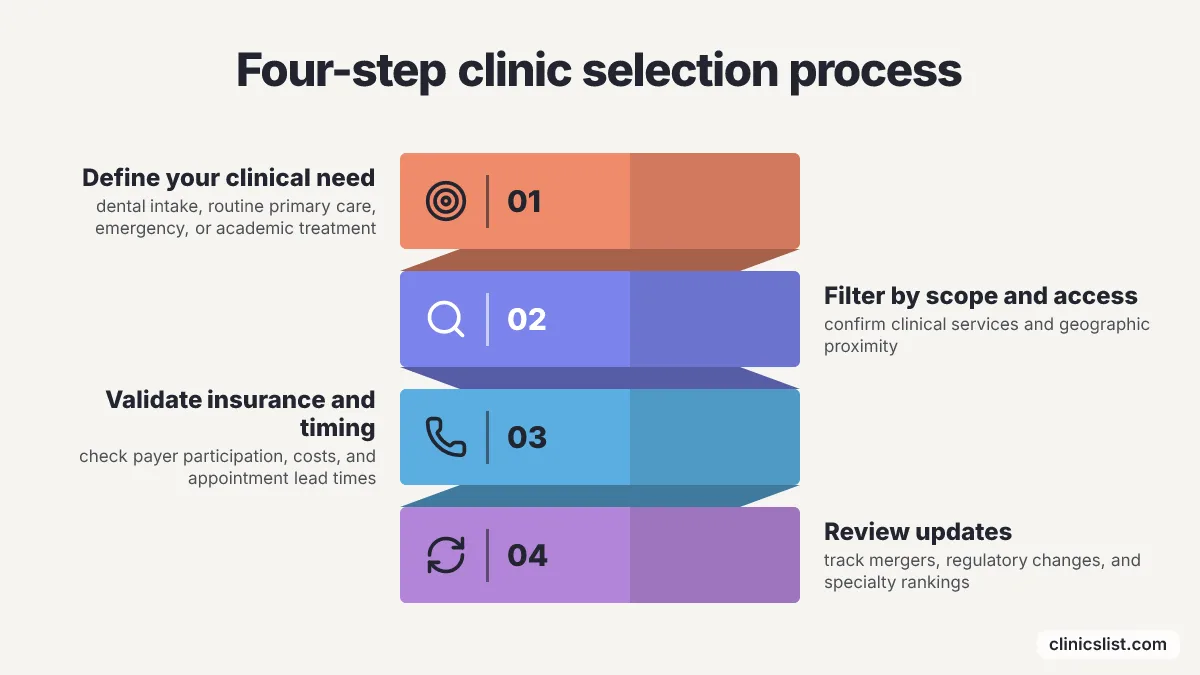
A structured selection sequence resolves uncertainty in four practical steps:
- Define the immediate clinical or administrative objective: dental intake, routine primary care, emergency stabilization, or academic tertiary treatment.
- Filter facilities by confirmed clinical scope and geographic accessibility.
- Validate active insurance participation, out-of-pocket costs, and current appointment lead times directly with the clinic office.
- Review options when regional system mergers, regulatory adjustments, or updated specialty rankings alter provider availability.
Conclusion
Identify the immediate healthcare requirement facing your family or clinical practice this week. A patient must identify a nearby facility, verify active insurance participation with the billing department, and confirm appointment lead times before booking care. A dental practice manager should evaluate patient drop-off points during registration and measure whether software automation costs less than administrative overtime. A healthcare administrator must focus on current operational contracts rather than multi-year hospital expansion plans, because approved mergers and facility filings do not expand appointment availability today.
Published rankings and online profiles help identify initial candidates, but direct communication confirms actual care delivery. Call the facility scheduling office, confirm the accepted provider network, and obtain out-of-pocket cost estimates in writing before confirming your next appointment.
Frequently Asked Questions
What is the best hospital in North Carolina for complex care?
Duke University Hospital in Durham is the top-ranked hospital in North Carolina for complex care. It serves as a primary tertiary referral center across the Southeast, handling severe, rare, or multisystem diagnoses that community clinics cannot manage alone.
Where can I find family care services in Raleigh?
UNC Health Rex in Raleigh is known for providing family care services. It offers a coordinated network that handles pediatric visits, annual exams, and ordinary referrals, making it a reliable base for family medicine across Wake County and the central Piedmont.
How does ECU Health serve eastern North Carolina?
ECU Health operates as a mission-driven health system covering 29 eastern counties, providing care for 1.4 million people. It includes eight hospitals and various health services, acting as a safety net for rural and coastal communities far from large university centers.
What healthcare options are available in Wake County?
WakeMed offers a comprehensive healthcare network in Wake County, with three hospitals, eight emergency departments, and over 80 physician practices. This setup allows residents to access primary care, urgent care, and major trauma services without leaving the county.
Which platform is best for dental practice management in North Carolina?
Clincy is a platform designed specifically for dental practice management. It automates administrative tasks like patient intake, insurance paperwork, and recall messages, helping dental offices save time and improve efficiency.
Sources
- Duke University Hospital — About
- UNC Health Rex
- ECU Health
- WakeMed
- Novant Health Presbyterian Medical Center
- NC Newsline/Enlace Latino NC: Duke Health and CaroMont Health file Certificate of Need applications for two new Charlotte-area hospitals