Summary: The top obstetrical care clinics in California include UCLA Health OBGYN for birthing-center breadth, UCSF Department of Obstetrics for research depth, Keck Medicine of USC for high-volume academic training, UC Davis Health for Sacramento academic care, Orange Coast Women’s Medical Group for South Orange County team care, and California Obstetrics & Gynecology Institute for Bakersfield obstetrics. Each offers unique strengths, from academic depth to team continuity and local accessibility.
The referral coordinator says the first prenatal opening is on the other side of town, and the insurance card in your hand starts to matter less than the place where the baby will actually be born. A pregnancy search in California can get complicated fast once hospital access, midwifery care, postpartum support, and specialist backup enter the picture.
California obstetrical care should be picked by delivery path, not by name recognition alone. A large academic department, a community practice, and a midwife-inclusive group solve different problems. The shortlist should begin with the birth setting, the clinical team, and the handoff plan if risk changes.
Our directory includes a large number of Obstetrics & Gynecology clinics across many cities, and many of the listings that carry a rating are rated highly. Search radius still matters, but ratings alone cannot tell you whether a clinic fits a high-risk pregnancy, a midwife preference, or a delivery hospital constraint.
1. UCLA Health OBGYN: best for birthing-center breadth
UCLA Health OBGYN is a Los Angeles program where obstetricians and certified nurse midwives provide care at birthing centers the program describes as offering some of the most complete services in Southern California. Patients who want an academic medical setting with both OB and certified nurse midwife involvement have a clear reason to put UCLA Health near the top of the call list.
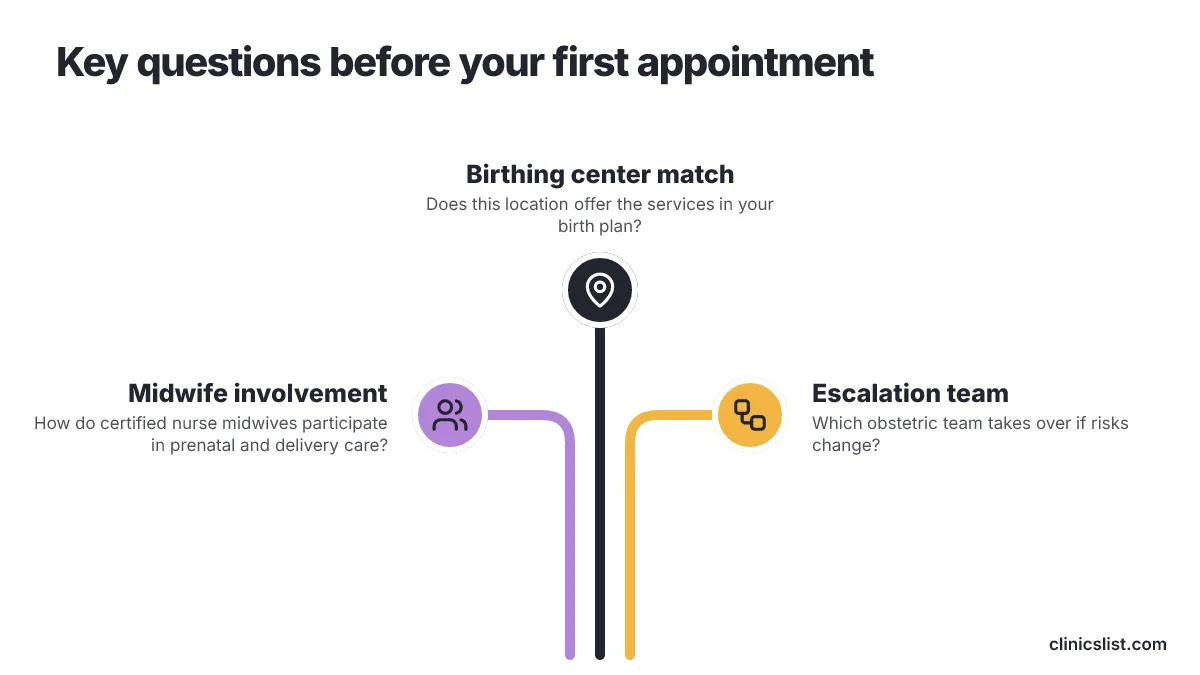
For UCLA Health, the practical question is whether the specific birthing center, clinician type, and insurance path match the pregnancy plan before appointments start. A patient who wants midwife-led care should ask how certified nurse midwives take part during prenatal visits and delivery. A patient with higher-risk concerns should ask which obstetric team handles escalation inside the same program.
2. UCSF Department of Obstetrics, Gynecology & Reproductive Sciences: best for research depth
UCSF Department of Obstetrics in San Francisco says that for nearly twenty years its Department of Obstetrics, Gynecology & Reproductive Sciences has consistently ranked number one or number two for National Institutes of Health grant funding among ob/gyn departments around the country. Research strength does not answer a scheduling question by itself, but it does point to a department built around complex clinical knowledge and academic infrastructure.
Patients considering UCSF should treat the research profile as a reason to ask sharper questions, not as a substitute for fit. The next questions are which UCSF site handles the pregnancy, which clinicians take part in prenatal care, and how the department manages transitions between routine obstetrics and higher-complexity care.
3. Keck Medicine of USC: best for high-volume academic training
Keck Medicine obstetrics department is based in Los Angeles, and the department reports that residents see more than 10,000 deliveries, over 5,000 major gynecologic surgeries, and roughly 11,000 gynecologic oncology clinic visits each year. That scale makes Keck Medicine most relevant for patients who want a large academic environment with broad exposure across obstetrics and gynecology.
The trade-off with a high-volume teaching department is simple enough. Patients should ask who they will see at each point in care. A good intake call asks whether residents, attending physicians, and other clinicians take part in prenatal visits, how labor coverage works, and which hospital policies affect birth preferences.
4. UC Davis Health Obstetrics and Gynecology: best for Sacramento academic care
UC Davis Health obstetrics runs its obstetrics and gynecology clinic in Sacramento as a four-year ACGME-accredited postgraduate residency training program based at UC Davis Medical Center. For people nearby who want prenatal visits connected straight to a teaching medical center, UC Davis Health belongs on the list. The academic setting adds order and clinical depth, which matters.
Training programs can talk at length about curriculum on paper, and that still leaves the everyday appointment unanswered. Ask the intake desk who will actually see you at each visit, where you deliver, and who answers when something feels wrong at two in the morning.
5. Orange Coast Women's Medical Group: best for South Orange County team care
Operating out of a Laguna Hills office in South Orange County, Orange Coast Women's Medical Group brings together board-certified ob-gyns, nurse practitioners, and certified nurse midwives under one roof for general obstetrics and gynecology in Orange County. Patients who want a mixed-staff model get an alternative to the huge university hospital systems.
That blend of providers is the big draw.
Before you sign on, though, learn how the work gets divided. Ask who handles routine prenatal visits, which doctor or midwife covers deliveries on a given night, and what happens to midwife care if the pregnancy needs a physician to take over.
6. California Obstetrics & Gynecology Institute: best for Bakersfield obstetrics
California Obstetrics & Gynecology Institute handles full obstetrical care for expectant mothers out of Bakersfield. For families weighing local appointments against a long highway drive to regional medical centers across California, this office gives them an obstetrics practice close to home. The clear benefit is convenience, especially when visits move to every week in the third trimester.
What still needs checking is the hospital network behind them. Find out which hospital handles deliveries, which outside specialists step in if complications appear, and how the clinic handles postpartum check-ins after you leave the recovery room.
How should you choose among California obstetrical care clinics?
The first call should confirm the delivery location, the care team and the escalation plan before a patient compares reviews. A beautiful clinic profile does not answer whether the same system can handle a change from routine prenatal care to urgent evaluation, so the call script should start with where delivery happens and who takes over when risk changes.
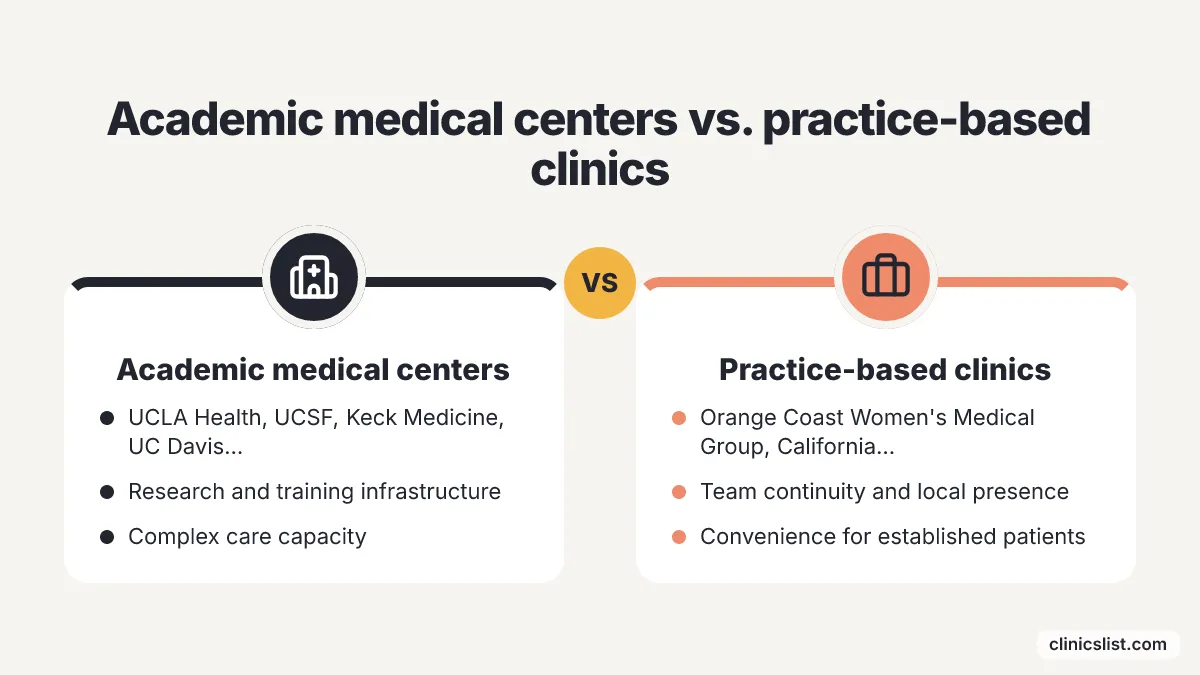
A practical shortlist should separate academic medical centers from group practices. UCLA Health, UCSF, Keck Medicine of USC and UC Davis Health all present academic or medical-center features in the supplied materials, while Orange Coast Women's Medical Group and California Obstetrics & Gynecology Institute read more like practice-based options tied to their local markets. The better choice depends on whether the patient values academic depth, team continuity, proximity or a specific clinician model.
California access is changing enough that patients should verify labor and delivery availability, not assume a known hospital still offers it. In October 2026, Santa Cruz Local reported that the Watsonville Community Hospital board voted to close labor and delivery after leaders warned the hospital could run out of money within a year, meaning Pajaro Valley patients would need care in Salinas or Santa Cruz through the Watsonville labor closure vote. For patients whose nearest maternity unit is closing, a ranked clinic list is the wrong starting point; confirming the open delivery site comes before choosing any prenatal office.
California policy changes also make the intake call more important for coverage and postpartum planning. In September 2026, Governor Gavin Newsom signed SB 626, which will require health plans to provide care coordination for perinatal patients who screen positive for mental health concerns starting January 2027, while he vetoed AB 2066, which would have let pregnant patients change health coverage outside normal enrollment windows, according to the care coordination law. A patient who expects a coverage change should ask the clinic and health plan about network rules before transferring care.
Midwifery authority is another reason to ask who can do what inside a practice. In September 2026, Governor Gavin Newsom signed nine reproductive-health bills, including AB 1696, which expands emergency services and care authority for nurse-midwives and expands who can legally deliver certain obstetric services, according to the nurse-midwife authority expansion. Patients who prefer certified nurse midwife involvement should ask whether the clinic's model allows midwives to participate throughout pregnancy, delivery and urgent situations.
Billing rules matter most for patients with Medi-Cal and for clinics preparing claims. In November 2026, the California Department of Health Care Services, reported through the California Medical Association, said Medi-Cal encourages obstetrical providers to submit claims for prenatal and postpartum care using evaluation and management codes with modifier TH ahead of a full maternity coding overhaul in 2027 through the Medi-Cal obstetrical billing guidance. A Medi-Cal patient should ask whether the clinic accepts the plan for prenatal care, delivery-related care and postpartum visits before assuming one acceptance answer covers the full pregnancy.
ClinicsList is a searchable, verified database of 90,000+ U.S. clinics across specialty categories, with filters for location, insurance, language, rating, telehealth and online booking through its verified clinic database. The median rating across the 1,671 rated Obstetrics & Gynecology listings in our directory is 4.4, and the median rated listing carries 84 reviews, so a high star rating should be read beside review volume and service fit.
Rating context has limits across healthcare categories. The MVP Dental practice is a Dental practice with a 5/5 rating from 270 reviews, which is a strong rating signal in its category, but obstetrical care selection has extra questions about delivery site, clinician coverage and postpartum support that a star score cannot answer by itself.
Clinic owners and investors should read the same search pattern as evidence of patient demand for verified, comparable information. Owners studying how California practices appear in directories can compare the mechanics in California clinic listing strategy, while patients should keep the focus on appointment access and birth-setting fit.
When to seek urgent care during pregnancy
Choosing a clinic is a planning task, but some symptoms during pregnancy or after birth need medical care right away rather than a scheduled appointment. The CDC's urgent maternal warning signs include:
- A severe headache that does not go away, or changes in vision
- Dizziness or fainting
- Trouble breathing, chest pain or a fast-beating heart
If any of these happen, get medical care right away and tell the care team that you are pregnant or were recently pregnant. Do not wait for the next routine prenatal visit.
Next steps: building your obstetrical clinic call list
The next move is a short call list, not another broad search. Pick the closest suitable option, one academic medical-center option and one group-practice option if the locations are workable, then ask each office where delivery happens, which clinicians provide prenatal care and what changes if risk rises during pregnancy.
A patient with Medi-Cal, a midwife preference or a recent coverage change should ask those questions before sending records. A clinic that answers clearly about delivery site, care team and postpartum follow-up deserves the next appointment; a clinic that cannot answer those points is not ready to be the only option on the list.
Frequently asked questions about California obstetrical care clinics
What are the best obstetrical care clinics in California?
The article identifies the top obstetrical care clinics in California as UCLA Health OBGYN, UCSF Department of Obstetrics, Keck Medicine of USC, UC Davis Health, Orange Coast Women's Medical Group, and California Obstetrics & Gynecology Institute. Each clinic offers unique strengths, such as academic depth, team continuity, and local accessibility.
Which clinic is best for midwife-led care in California?
UCLA Health OBGYN is noted for its birthing-center breadth and involvement of certified nurse midwives. Patients interested in midwife-led care should inquire about the role of certified nurse midwives during prenatal visits and delivery at this clinic.
What makes UCSF Department of Obstetrics stand out?
UCSF Department of Obstetrics is recognized for its research depth, consistently ranking high in National Institutes of Health grant funding. This research strength suggests a department built around complex clinical knowledge, making it suitable for patients seeking advanced academic infrastructure.
Why choose Keck Medicine of USC for obstetrical care?
Keck Medicine of USC is best for those seeking a high-volume academic training environment. The department handles a large number of deliveries and surgeries, providing broad exposure across obstetrics and gynecology, which can be beneficial for patients wanting comprehensive academic care.
How does California Obstetrics & Gynecology Institute benefit Bakersfield residents?
California Obstetrics & Gynecology Institute offers full obstetrical care in Bakersfield, providing convenience for local families. This clinic allows patients to avoid long drives to regional medical centers, especially important when frequent visits are required in the third trimester.
What should you ask an obstetrical clinic before the first appointment?
Ask three questions before sending records:
- Where does delivery happen?
- Which clinicians provide prenatal care?
- What changes if risk rises during pregnancy?
Patients with Medi-Cal, a midwife preference or a recent coverage change should also confirm that the clinic accepts their plan for prenatal care, delivery-related care and postpartum visits.
Should you choose an academic medical center or a group practice?
The better choice depends on whether you value academic depth, team continuity, proximity or a specific clinician model. UCLA Health, UCSF, Keck Medicine of USC and UC Davis Health offer academic medical-center settings, while Orange Coast Women's Medical Group and California Obstetrics & Gynecology Institute are practice-based options tied to their local markets.
Why confirm that a hospital still offers labor and delivery?
California maternity access is changing, so a known hospital may no longer deliver babies. Santa Cruz Local reported in October 2026 that the Watsonville Community Hospital board voted to close labor and delivery, so patients should confirm the open delivery site before choosing a prenatal office.