Summary: For multi-location practices in Illinois seeking the best patient review management service, ClinicUp is ideal for healthcare-focused review generation in Chicago, while MedMind Marketing offers healthcare-only compliance expertise. BRD Media LLC provides local coverage in DuPage County and Chicago, MGMT Reputation handles complex cases, ORM Chicago integrates reputation with marketing, and SEO Design Chicago covers broad reputation channels.
A multi-location practice in Illinois faces a distinct operational hurdle when patient feedback splits unevenly across branches. When an outpatient group operates clinics in downtown Chicago, Naperville, and Schaumburg, a 3.8-star score at one suburban site drags down patient intake across the entire network. Finding the best patient review management service for multi-location practices in Illinois requires looking past simple star collection to find strict governance, healthcare compliance, and active listing control.
Star ratings vary widely between the clinics listed in our directory.
That spread shows that a strong public rating cannot be taken for granted across regional directories. Most practices stay exposed when prospective patients compare nearby medical offices. That gap directly affects patient volume, because review profiles now double as direct digital access points. Public feedback functions as an immediate scheduling intake point rather than a passive marketing archive.
During December 2025, Zocdoc and Healthgrades launched real-time appointment booking directly on Healthgrades directory listings, enabling patients to inspect doctor ratings and confirm an appointment on the exact same screen. Medical groups managing multiple facilities across Illinois must evaluate agencies by how well they protect compliance, follow search engine rules, and handle location-level operations.
1. ClinicUp: best for healthcare review generation in Chicago
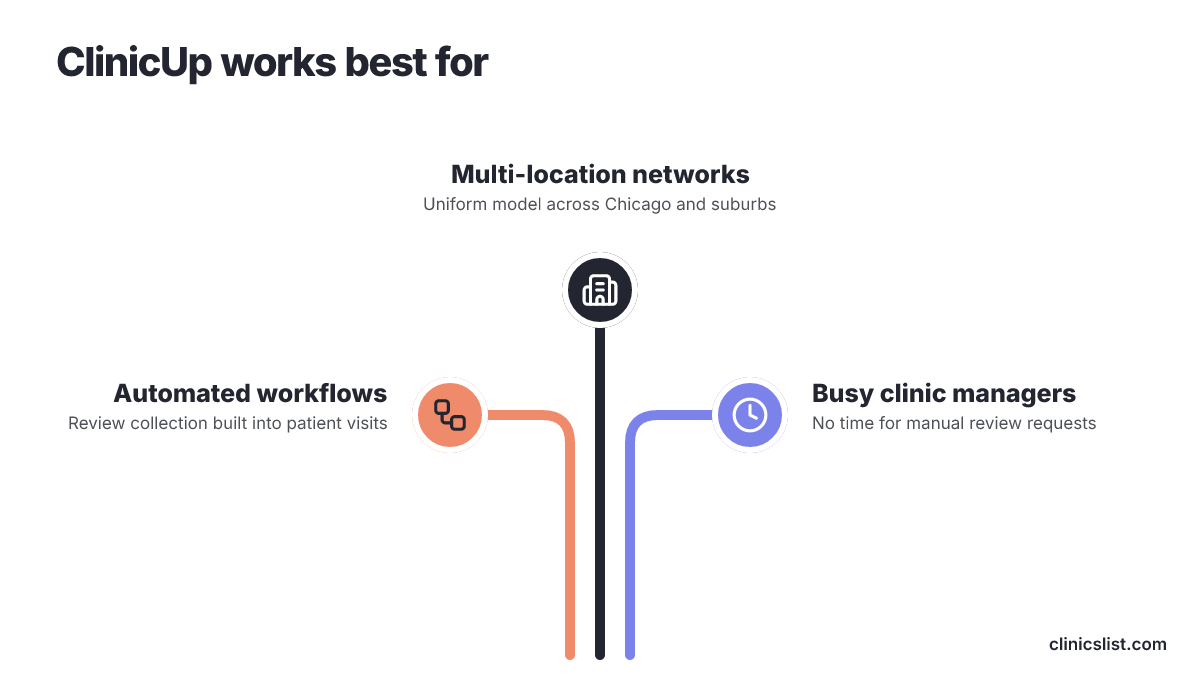
ClinicUp healthcare reputation management provides focused review generation and reputation management designed specifically for medical practices using field-tested strategies throughout the Chicago area. The company stands out for Illinois groups that want automated review collection built directly around medical patient workflows rather than broad retail campaigns. Medical groups with steady patient volume across several facilities benefit most from ClinicUp when local clinic managers lack the hours to monitor reviews, send follow-up requests, and draft branch-specific replies. The firm's local focus helps regional healthcare networks that need a uniform operating model across central Chicago facilities and outlying suburban clinics.
The service is less practical for an organization that merely needs a one-time profile update or a handful of canned response templates. A multi-location healthcare network should ask ClinicUp how its software manages invitation intervals across different sites, especially since Google's updated rules penalize practices that use aggressive review targets.
2. MedMind Marketing: best for healthcare-only compliance focus
MedMind healthcare reputation management concentrates exclusively on healthcare clients, guiding medical practices through patient feedback strategies, strict HIPAA boundaries, and state medical regulations. The agency serves groups that view online patient commentary through the lens of legal liability and privacy standards rather than public relations. MedMind fits regional medical groups where front-desk coordinators, attending physicians, and administrative leaders all interact with patient feedback channels. Healthcare specialization is mandatory when a published response must acknowledge a patient's frustration without confirming their diagnosis, clinical care, appointment date, or billing details.
This dedicated compliance setup offers more oversight than necessary for a small solo office with a single reception desk, one Google listing, and low monthly patient turnover. Regional Illinois practices should question MedMind about their training modules for facility managers, because regulatory missteps multiply quickly when decentralized branch staff write unvetted public replies.
3. BRD Media LLC: best for DuPage County and Chicago coverage
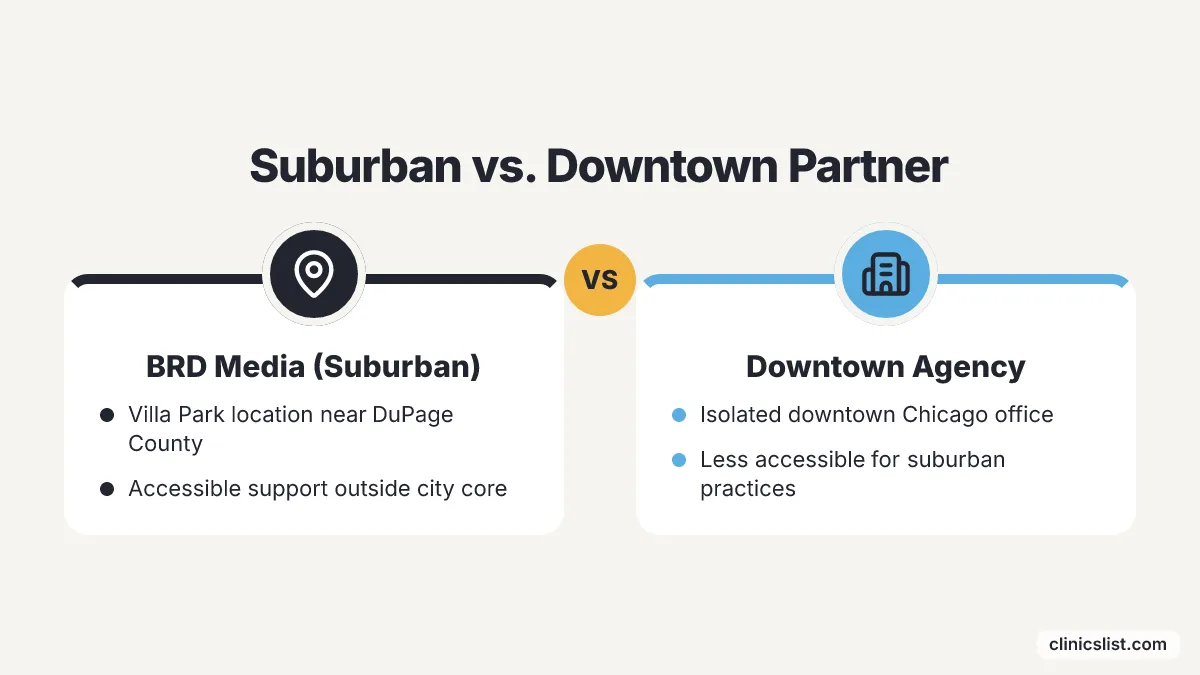
BRD Media reputation management operates out of Villa Park, Illinois, providing review management coverage to practices located across DuPage County and the greater Chicago region. This vendor provides an alternative for medical networks seeking a suburban partner rather than an agency isolated in downtown Chicago. The firm is structured well for practices with offices spread between DuPage County towns and central city neighborhoods, giving practice directors accessible support outside the city core. Regional proximity does not replace medical industry experience, so clinical directors should inspect prior healthcare campaigns before hiring BRD Media LLC to handle complex patient grievances.
Healthcare networks should examine how the firm structures daily operations: which team member tracks individual location listings, who signs off on public text, and how the system prevents staff members from pushing patients for personal reviews. Working with a suburban vendor does not automatically fix review administration unless each physical location abides by the same operational guidelines.
4. MGMT Reputation: best for complex reputation cases
MGMT Reputation Chicago service handles reputation work from Chicago, with a central control point built to sort out high-friction online reputation problems across the country. That setup suits organizations dealing with ugly public disputes, long runs of negative comments, or search problems that refuse to settle down. For a multi-site practice, the service makes sense when top leadership wants one team directing a messy online crisis across several regional branches. Some cases are plain hard. Conflicting profile records, review attacks that seem coordinated, and search results that still show an old version of the practice all push the work toward a more forceful admin model.
For a healthcare practice whose main need is fresh praise from satisfied patients, that defensive setup goes too far. Illinois medical leaders need to separate crisis suppression from routine patient feedback collection, because the two jobs use different tools, different timelines, and different staff time.
5. ORM Chicago: best for established Chicagoland marketing support
ORM Chicago online reputation management has worked with businesses across Chicagoland since 2016, operating from 445 E. Ohio St., Chicago, Illinois 60610. The company fits groups that want review monitoring folded into a broader patient acquisition and marketing program they already run. Multi-branch healthcare practices can gain by tying patient reviews to local organic search rankings, site updates, and patient conversion paths. When those pieces sit together, reputation work does not drift off into its own corner and ignore the clinic's marketing spend.
Practices that want a medical-only partner may find this cross-industry marketing setup less suited to their clinical workflow. Multi-location healthcare groups should check how ORM Chicago trains staff on HIPAA response limits, because healthcare accounts follow rules that commercial marketing accounts do not.
6. SEO Design Chicago: best for broad reputation channels
SEO Design Chicago reputation management handles brand reputation across major search engines, social media networks, and corporate directories. That makes the firm a fit for medical organizations that have to watch patient interactions across several public channels, not just local map listings.
The agency works for large healthcare groups whose patients leave comments on local maps, community forums, and commercial social channels at the same time. Running clinics in several regions brings different problems. One location may be stuck with low star ratings on search listings, while another draws heated complaints on social media, so the team needs broad oversight.
A multi-channel plan like that adds extra overhead for a group that only needs steady Google Maps feedback. Multi-site clinic operators should look at which channels bring in most new patient bookings, so the admin team does not spend time and money on channels that do little.
How to choose a service for multiple Illinois locations
Picking an agency starts with checking how each branch handles patient contact. A medical group with sites across Illinois needs the same review request rules at every office, one approval path for public replies, and a dashboard that spots the locations lagging behind.
Google changed its Maps policies in April 2026, as reported by PPC Land, and it plainly banned staff-name and quota-based review solicitation under stricter rules against rating manipulation. Practice directors should stop internal contests that hand out monthly review quotas to branch staff, because employee targets can bring account penalties under platform rules.
Google Maps also rolled out automated defensive protections in April 2026, using Gemini models to spot suspicious address edits, blocking digital extortion schemes, and sending immediate email alerts to verified Business Profile administrators, based on Google Maps protection reporting. Regional Illinois practices should confirm primary ownership over every branch listing, since fast verification alerts are needed to catch unauthorized listing changes before they interfere with patient booking paths.
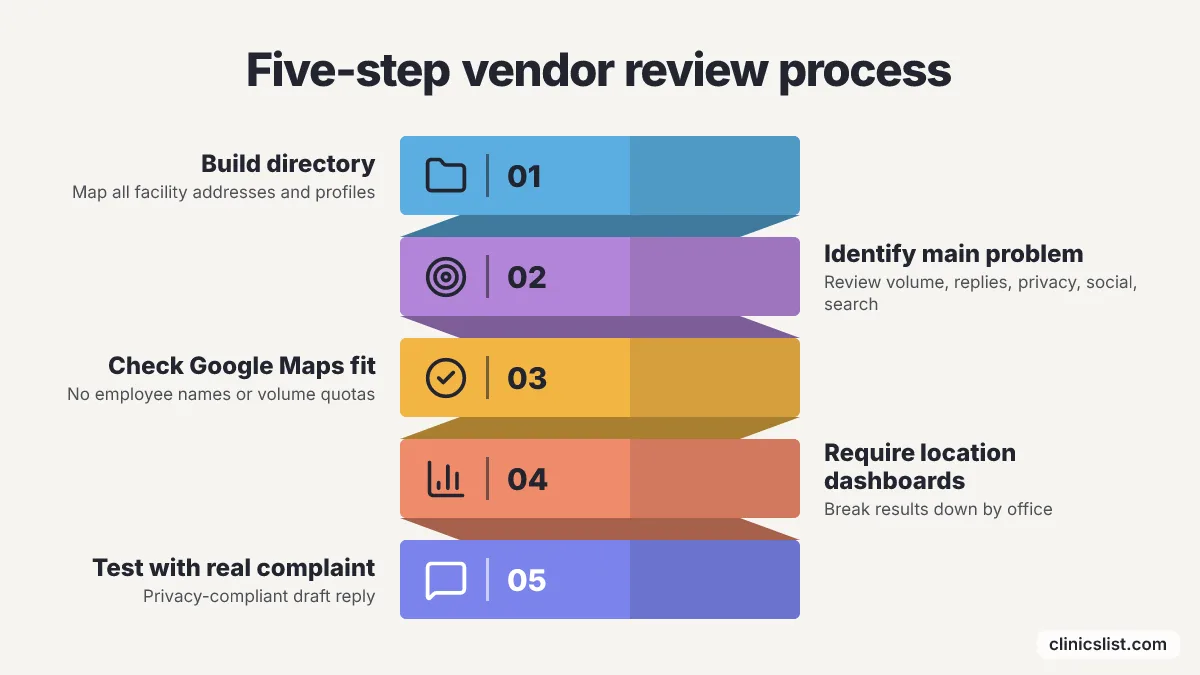
Practices can judge prospective review vendors with a five-step review process:
- Start by building a full directory of every facility address, map profile, and third-party appointment listing before any agency sales call begins. A branch that never gets tracked cannot be guarded against rogue edits or negative feedback.
- Decide whether the main problem is low review volume, uneven public replies, patient privacy worries, social media feedback, or damaged search results.
- Ask each prospective agency to explain how its review invitation sequences fit the April 2026 Google Maps updates. A safe operating system leaves out employee names and drops volume quotas for branch staff.
- Require dashboards that break results down by location. A network average hides the office dealing with delays, stale listings, or disengaged reception personnel.
- Hand candidates a real, difficult patient complaint as a test case. Their draft reply has to stay polite, follow medical privacy rules, and give the regional clinic manager useful context.
A single-provider office in Kansas or an independent pediatric practice in Colorado should not hire an Illinois multi-location agency. A solo clinic does better with an internal front-desk routine and a monthly review audit before it spends money on outside agency retainers. That limit changes only when a practice starts expanding across several sites. ClinicsList runs a searchable verified clinic database covering 90,000+ U.S. Medical locations arranged by medical specialty, geographic market, accepted insurance plans, languages spoken, patient ratings, and digital booking features. Directory platforms matter to clinic groups because consumers compare healthcare providers across large listing databases instead of looking only at practice websites.
Practice managers who want to standardize intake communication before they sign an agency contract can download the ClinicsList Free Patient Review Request Kit to line up messaging across regional facilities. A standardized patient communication script cannot replace dedicated software, but it sets compliant internal standards across front-desk teams right away.
Dental networks have extra technical layers to handle when clinical discussions connect diagnosis, radiography, patient billing, and case acceptance. The VELMENI unified AI platform is described by its maker as a unified dental AI platform that combines 2D and 3D diagnostic imaging, insurance claims processing, and voice transcription within an FDA-cleared framework. Dental groups need to keep diagnostic software separate from public marketing platforms while keeping the patient experience steady across all touchpoints.
During September 2026, Zocdoc said that its Care Access Network expansion lets patients book appointments across partner services, sending booking options to Amazon Health AI, Gemini, Yelp, Healthgrades, Blue Shield of California, and general search directories. Reputation management has to connect review monitoring, listing accuracy, and appointment availability, because patients often schedule care directly from the platform that shows the reviews.
Next steps before you contact Illinois review management vendors
Before you schedule any first calls with vendors, write down every physical site you run. The management team should put each Google Business Profile, regional directory entry, online booking portal, and front desk screen into one central register before anyone starts comparing agencies.
Open the conversation with the firm that matches the network's weakest point. That could be healthcare compliance rules, Chicago market knowledge, suburban DuPage reach, crisis handling, full-service digital marketing, or tracking a brand across several platforms. Ask for written scripts for review requests, patient privacy response steps, and a sample report for one location. Drop any provider that cannot explain how its software fits Google's 2026 review policies, because a larger review count means little if it puts profile access at risk.
Frequently Asked Questions
What is the best patient review management service for multi-location practices in Illinois?
ClinicUp is ideal for healthcare-focused review generation in Chicago, while MedMind Marketing offers healthcare-only compliance expertise. BRD Media LLC provides local coverage in DuPage County and Chicago, MGMT Reputation handles complex cases, ORM Chicago integrates reputation with marketing, and SEO Design Chicago covers broad reputation channels.
Why is ClinicUp recommended for healthcare review management in Chicago?
ClinicUp provides focused review generation and reputation management specifically for medical practices in Chicago. It is designed for medical groups with steady patient volume across several facilities, offering automated review collection built around medical patient workflows.
How does MedMind Marketing ensure compliance in healthcare review management?
MedMind Marketing concentrates exclusively on healthcare clients, guiding medical practices through patient feedback strategies, strict HIPAA boundaries, and state medical regulations. This dedicated compliance setup offers oversight to prevent regulatory missteps when responding to patient feedback.
What makes BRD Media LLC suitable for practices in DuPage County and Chicago?
BRD Media LLC provides review management coverage to practices across DuPage County and the greater Chicago region. It offers accessible support for practices with offices spread between suburban towns and central city neighborhoods, making it a good fit for those seeking a suburban partner.
How does SEO Design Chicago manage reputation across multiple channels?
SEO Design Chicago handles brand reputation across major search engines, social media networks, and corporate directories. This makes it suitable for medical organizations that need to monitor patient interactions across several public channels, ensuring broad oversight for clinics in multiple regions.
Which Illinois review management service suits complex reputation cases?
MGMT Reputation handles reputation work from Chicago and suits organizations dealing with public disputes, long runs of negative comments, or search problems that refuse to settle down. A practice whose main need is fresh reviews from satisfied patients may find that defensive setup goes too far.
Can ORM Chicago combine review management with practice marketing?
ORM Chicago fits groups that want review monitoring folded into a broader patient acquisition and marketing program, tying patient reviews to local organic search rankings, site updates and patient conversion paths. Healthcare groups should check how it trains staff on HIPAA response limits.
How do Google's 2026 Maps review policies affect multi-location practices?
Google banned staff-name and quota-based review solicitation in April 2026, as reported by PPC Land, so practices should stop internal contests that set monthly review quotas for branch staff. Each location's review invitations should leave out employee names and volume targets.
Should a solo or small practice hire a multi-location review agency?
A single-provider office or an independent practice usually does better with an internal front-desk routine and a monthly review audit before paying for an outside agency retainer. That changes once the practice starts expanding across several sites.
Related reading
- 6 Family Health Medical Services in Jamestown, NY, Compared
- 6 Services to Reactivate Dental Patients in the USA
- Preventable vs Non-Preventable Denials Management
Where to go next
Sources
- Reputation Management Chicago — BRD Media LLC
- Reputation Management Chicago IL — MGMT Reputation
- Online Reputation Management Chicago — ORM Chicago
- Healthcare Reputation Management in Chicago — ClinicUp
- MedMind Marketing — Online Reputation Management Company Chicago
- Chicago Reputation Management — SEO Design Chicago