
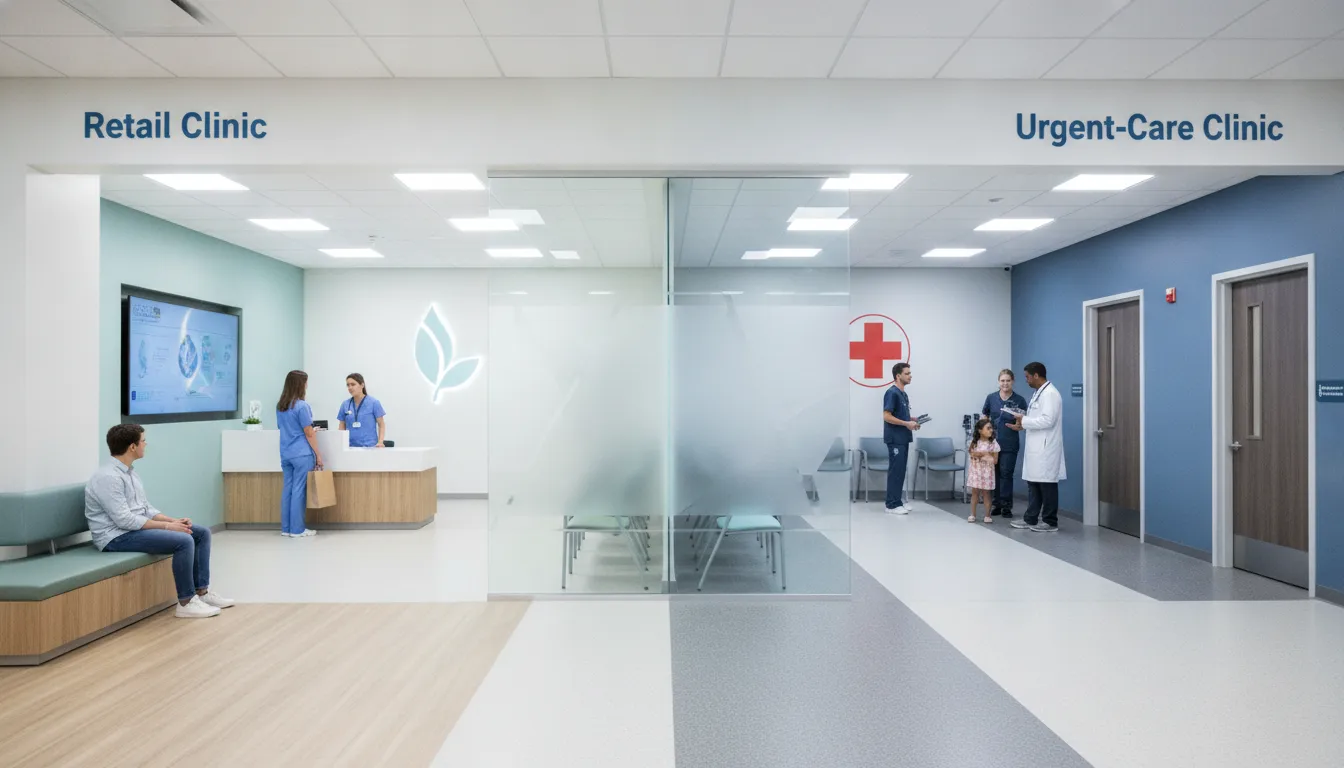
Summary: For quick, non-emergency medical needs, retail clinics and urgent-care centers offer convenient options. Retail clinics, often in pharmacies or grocery stores, handle minor issues like vaccinations and simple screenings. Urgent-care centers are equipped for more serious conditions, such as fractures and moderate burns, with on-site X-rays and lab tests. Both options provide transparent pricing, making them cost-effective alternatives to emergency rooms.
Across the country, close to 30% of Americans people lean on retail clinics and urgent-care centers for basic treatment. Primary care offices can book out for weeks. So people go online and hunt for a wellness clinic near me that can see them sooner.
These walk-in sites sit between a regular doctor visit and an emergency room bill that can make your stomach twist before anyone has even said what’s wrong. They’re built for speed, and they’re built so prices can be read before you sign in. That matters.
Choosing the right place means checking what it can treat, what you’ll owe out of pocket, who works there, and whether your records can follow you later. A sore throat is one thing. A broken bone is another.
Key Takeaways
Retail clinics are the easy stop. They live inside pharmacies and grocery stores, handle vaccines, routine screenings, and minor illnesses, and usually rely on nurse practitioners or physician assistants. Urgent care is broader. These centers often keep X-ray and lab equipment on site, so they can deal with cuts, fractures, and other problems that need more than a quick look.
Prices are usually clearer than they are at an emergency room. That helps people paying cash, people with thin insurance, and people whose coverage still leaves them staring at a painful bill. Staffing also differs. Retail clinics usually run on nurse practitioners and physician assistants. Urgent care centers often have physicians present.
Your regular doctor still matters. A walk-in visit solves the immediate problem, but the record has to move if you want the full story later.
How Do Retail Clinics Operate?
Retail clinics are walk-in care sites tucked into grocery stores, pharmacies, and big-box retailers. They’re built for low-complexity visits. Nurse practitioners and physician assistants usually staff them, and they focus on vaccinations, rapid tests, simple screenings, and a small set of common complaints, all with prices people can see before they commit.
That narrow scope is the whole trick. It keeps overhead down and keeps the line moving. You can walk into a pharmacy, join a digital queue, get checked, and often leave with a prescription at the same counter in about thirty minutes. Strep throat, mild ear infections, seasonal allergies, urinary tract infections, and routine immunizations fit here. Deep wounds, serious trauma, and complicated workups do not.
The business model depends on volume and a short menu of services. There’s no imaging wing, no surgery supply closet, and no reason to build for rare edge cases. Small staff. Small footprint. Fast turnover. When symptoms look severe, or the patient looks unstable, the clinic sends them elsewhere.
For self-pay patients and busy people who just need a routine check, that tradeoff makes sense. These clinics also give underserved urban and suburban neighborhoods a place to get seen when regular offices keep short hours or stay booked solid.
What Makes Urgent-Care Clinics Different?
Urgent-care clinics occupy the middle ground. They see problems that need help today, yet they are no place for a helicopter landing.
That distinction matters. These clinics usually have physicians, physician assistants, and nurses on site, and they handle deep cuts, moderate burns, asthma flare-ups, and broken bones. The hours are a tell too. Most stay open evenings, and they often run seven days a week.
Retail clinics work on a smaller scale.
Urgent care keeps more inside the building: digital X-ray machines, lab tests, IV fluids, and tiny procedure rooms. One visit can cover a lot of ground. A fracture gets splinted. A cut gets stitched. A breathing treatment starts right away. The patient walks out without crossing town for the next stop.
That setup also takes pressure off local emergency rooms. Urgent care absorbs the middle cases, the ones that clog chairs but do not belong in the trauma bay.
The bill is higher, of course. Clinical staff, equipment leases, and regulatory oversight all add up. Most centers keep a physician involved, on duty or on call, while advanced practice providers do much of the day-to-day work. That gives them room for bad flu cases, abdominal pain, sports injuries, and work accidents that a pharmacy clinic can't handle.
Patients still dodge hospital facility fees. They still do not replace an emergency department for heart attacks or severe head trauma. They are the safety net for surprises.
Cost Shapes the Choice
Price pushes a lot of these decisions.
People compare pharmacy retail clinics, standalone urgent care, and hospital emergency departments, then pick the place that fits both the problem and the bill. Retail clinics are cheaper at the counter. A basic visit often runs from $50 to $150 for a simple diagnosis or routine shots. The fee is usually posted in the waiting area or online, so self-pay patients know what they're walking into. Billing stays plain because these clinics stick to low-acuity problems.
Urgent care costs more. Typical visits land between $150 and $350, since the visit may include lab work, X-rays, or suturing. That still sits far below an emergency department bill, which can climb into the thousands for a problem that is serious but not life-threatening. Most urgent-care centers also work with commercial plans, Medicaid, and Medicare.
Money matters. So does the injury. A simple preventive checkup belongs at retail. A wound that needs imaging or repair belongs at urgent care. Pick badly, and you may pay for two visits.
Keeping the Record Intact
Retail and urgent-care visits should not drift away from the rest of a patient's medical life. They need to land in the long-term chart. Otherwise the same test gets repeated, drugs clash, and nobody sees the whole picture.
The better walk-in clinics act like a branch of primary care, not a replacement for it. After the visit, they send an electronic summary with the diagnosis, shots given, vital signs, and prescriptions. If the records can talk to each other, the primary care doctor gets the note without extra chasing.
Some clinics use the Free Patient Review Request Kit to collect patient feedback about handoffs and follow-up. People notice whether the summary arrived, and whether prescription changes made it through.
Without that link, care breaks into pieces. Patients with hypertension or diabetes feel it first. A walk-in clinician changes a medicine, but the regular doctor never hears about it. Trouble follows. Clear referral loops and plain communication keep the convenience of walk-in care without losing the thread.
The Future of Retail and Urgent-Care Clinics
Retail clinics and urgent-care centers are drifting toward a mixed model. People still walk in. They also show up on video, send photos, and get machine-assisted screening before they ever reach a room. That’s the direction.
As demand for quick care keeps climbing, these clinics are taking on more than coughs and sprains. Some are adding chronic disease checks, mental health screening, and pediatric services. The menu keeps growing.
The front desk is changing fast. Kiosks handle intake. Remote monitors feed data back to staff. Shared patient portals cut down the old paper shuffle, and regional health systems are tying retail clinics into referral networks that move patients along with less friction.
Urgent-care chains are widening their own service lines too. Occupational testing, employer wellness visits, and post-op follow-up appointments are showing up more often. Retail clinics are doing a different kind of expansion, one that pulls them closer to larger health systems and makes them a first stop rather than a dead end.
Healthcare practices refining their public communications and regulatory alignment can use the Free Clinic Ad Compliance Checker to check that service claims and promotional outreach meet state and federal medical advertising rules. That matters. Clear advertising protects trust, and it keeps clinics out of trouble as their offerings shift.
Walk-in clinics are likely to become the front door for bigger care networks. Patients will get longer virtual consults, prescription delivery to the doorstep, and wellness monitoring that keeps track of problems between visits. Small visit, bigger web.
How to Choose Between Retail and Urgent-Care Clinics
The choice depends on the problem in front of you. Severity matters. So do imaging needs, provider skill, and cost.
A retail clinic fits predictable, minor issues. Think seasonal allergies, routine shots, basic screening, or a mild rash. Urgent care is for more complicated cases, like injuries that may need X-rays, deeper cuts, or pain that won’t settle down.
When deciding where to go, start with the body, not the building:
- Choose a retail clinic for: routine vaccinations, annual flu shots, biometric screenings, school or sports physicals, mild skin rashes, minor sore throats, and simple sinus or ear congestion.
- Choose an urgent-care clinic for: suspected fractures, deep cuts that need stitches, sprains and joint injuries, persistent high fevers, moderate asthma flare-ups, unexplained abdominal discomfort, or small burns.
- Choose an emergency room for: crushing chest pain, severe shortness of breath, sudden numbness or speech trouble, uncontrollable bleeding, head trauma with loss of consciousness, or major physical trauma.
People with chronic illness or complicated histories need to think about the next step too. A mild problem can be handled quickly in a retail clinic. When the picture is muddy, or the injury is more than minor, urgent care gives you more diagnostic backup.
The Impact of Digital Health Technologies
Digital tools are changing how retail and urgent-care clinics work. Scheduling gets handled by software. Virtual visits happen right away. Data moves between providers with less delay, and the old walls between systems are getting thinner.
That changes the waiting room first. Patients can book from home, see wait times before they leave, and fill out forms on a phone instead of a clipboard. Rooms stay less crowded, and fewer people sit around sharing the same air.
Telehealth modules matter too. A provider can sort simple problems online and keep the exam rooms open for cases that need hands-on care. It saves time. It also keeps staff focused on the patients who actually need to be seen in person.
Electronic health records are another big part of the picture. When those records connect with prescription monitoring databases and regional health exchanges, providers can check allergies, current medications, and prior diagnoses quickly. That helps avoid bad drug interactions, cuts down duplicate testing, and sends records back to family physicians without a long delay.
Conclusion
Retail and urgent-care clinics fill an important gap in modern healthcare. They give patients fast care, and the type of care depends on the setting. Retail clinics are better for routine prevention and minor illness. Urgent-care centers handle more serious diagnostics and procedures.
Use the right place for the right problem. Keep primary care in the loop. That’s how patients get prompt treatment without losing track of cost or safety.
Frequently Asked Questions
What services do retail clinics typically offer?
Retail clinics provide basic healthcare services such as vaccinations, health screenings, and treatment for minor illnesses like colds and flu. They are designed for convenience and quick access, often located within retail stores.
When should I visit an urgent-care clinic?
Urgent-care clinics are suitable for non-life-threatening emergencies that require immediate attention, such as fractures, cuts, or severe flu symptoms. They offer more comprehensive services than retail clinics and are open for extended hours.
How do costs compare between retail and urgent-care clinics?
Retail clinics generally offer lower costs for basic services compared to urgent-care clinics. However, urgent-care clinics provide a broader range of services at a higher cost, though still more affordable than emergency rooms.
Can retail and urgent-care clinics replace my primary care physician?
While these clinics offer convenient care options, they should not replace a primary care physician. Integration with primary care is essential for comprehensive healthcare management and continuity of care.
Are retail and urgent-care clinics covered by insurance?
Many insurance plans cover services at retail and urgent-care clinics, but coverage varies. Patients should check with their insurance provider to understand their benefits and any out-of-pocket costs they may incur.
Recommended resource
Related reading
- How to Choose and Switch Primary Care Providers: A Complete Guide
- How Healthcare System Culture Shapes Patient Safety: What Patients and Clinics Need to Know
- The Impact of Private Equity on Hospital Management: A Strategic Guide for Leaders
- Aesthetic and Cosmetic Clinic Patient Management Systems: Diabetes Offers & Affordability Options
Sources
- heyclincy.com
- Healthcare Leaders Discuss Concerns Over Medicaid Cuts, Requirement Changes with Goodlander (2026)
- Laurence I. Radin, MD | Hartford HealthCare | CT (clinic)
- Connect Physical Therapy LLC (clinic)
- Suncoast Rheumatology: Comprehensive Care (clinic)
- Meet the farmers growing medicine in the Mississippi Delta
- Free cancer screenings available at Husker Harvest Days
- Find a Diabetes Dietitian in West Virginia
- Discovery Call
- Dermatologist – Baton Rouge, LA at Louisiana Dermatology Associates (LA Dermatology) (job posting)
- Medical Director - Aesthetics (Dermatology or Plastics) - Georgia at Prairie (job posting)
- Board Certified Dermatologist (MD/DO) at Thomas Dermatology (job posting)
- Clinads (healthcare startup)
- Petros, Inc. | MedTech Executive Search (healthcare startup)
- Hindsait, Inc. (healthcare startup)
- Pediatric Urgent Care in Anaheim | Walk-In Clinic
- Florida Atlantic Medical Group - Primary Care
- Optum Ear, Nose and Throat (Otolaryngology) - Glen Cove, NY
- Weight Loss Center in St. Augustine | Crescent Beach Care
- Plattsburgh Family Health: Quality Primary Care ...
- Advocates urge awareness of postpartum depression warning signs, available help
- Cancer Institute
- Mount Carmel Heart & Vascular Specialists Hilliard
- Christopher Y. Maeda, MD | Bothell, WA - Providence
- Heart Center Doctors in Bradenton | HCA Florida Blake Hospital
- Find occupational health in Midland, MI
- the down and dirty truth of retail health

